
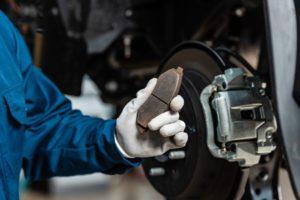
Professionals recommend changing your brake pads every 50000 miles or so. Depending on how much you drive your vehicle and how hard you are on the brake, you can give or take a few thousand miles. Discover how often should you change brake pads on your vehicle – read below and find out.
In this guide, we will help you determine how often you should change your vehicle’s brake pads, how you can tell if your pads need to be changed, and the reasons it is critical to do so.
How Often Should You Change Your Brake Pads
The time frame for changing your brake pads will differ from vehicle to vehicle, depending on the make and model of your car, the breaks you buy, and how often you drive.
On average, you should consider changing the brake pads on your vehicle about every 50,000 miles driven.
If you drive on well-paved roads and responsibly with a newer vehicle, you can probably get away with only changing out your worn brake pads every 7500 miles.
If you spend a lot of time driving habits that stress you vehicle, like driving on poorly paved or dirt roads, or if you have an older vehicle, it may be beneficial to change your worn brake pads closer to 25000 miles.
How to Tell When Your Brake Pads Need to be Changed
Just like any other part of a vehicle, you can easily tell when you need a brake service because of the signs your vehicle will start to show.
Some of the biggest indicators of brake pads needing to be replaced will rely on the sharpness of your senses.
Sounds
Listen to your brakes as you press on them. When your brake pads are starting to deteriorate, the metal-on-metal sound will cause an awful grinding or squealing noise that can’t be ignored. The longer you wait to change your brakes, the louder the noise will get and the more damage you will do to your vehicle.
Some brake pads even have a metal sensor that will make a high pitched screeching sound to warn you that the brake pad material is getting low. This is to help you prevent damaging your brake rotors and increasing the cost of the repairs.
Sight
If you take a quick look at your brake pads, and they seem a little thin or almost non-existent, then it is time to replace the pads before you have to replace much more.
Another more obvious tip that comes from the car itself is the lights. Most newer vehicles have warning lights that come on when it needs maintenance. You may see an ABS warning light appear on your dashboard (Anti-lock Brakes) or a brake system warning light.
While these can be helpful guides to indicate when a brake pad change is needed, they don’t always catch the problem, so this shouldn’t always be your relied-on indication.
Touch (Well, Feel)
When your brake pads are thin, they will not provide the same smooth stop as they once did. You will start to notice a vibration in the brake pedal and a slower stop time when it’s nearly time for a brake pad replacement.
When your vehicle reaches the point of a vibrating brake pedal, you may be looking at more expensive and profound repairs.
What Happens if You Wait Too Long to Change Your Brake Pads?
There are many significant reasons to change your brake pads on time or even sooner when the vehicle is telling you there is a problem.
Damaged Rotors
A brake pad’s job is to protect your rotors from metal-on-metal grinding when you push down the brakes, slowing the motion of the rotors. If you wear your brake pads down to a point where the padding is gone, and there is nothing but metal remaining, you will damage the brake rotor, which will now also need to be replaced.
Exploding Rotors
Yes, that is correct, your rotors can become so hot they can explode, and we have to tell you how much damage that can cause. Not only will you be looking at added expenses to replace the brake pads and brake rotors, but you are also possibly going to destroy the calipers, wheel bearings, and brake lines.
Your Car Won’t Stop
While this is not always the case, it is a definite possibility and has happened to many people. Those who have experienced this will tell you it is a scary situation.
When your pads wear away, they may get so low that they do not connect with the rotor and therefore do not stop the vehicle.
Note: You can avoid all of the issues above as long as your brake pads are properly installed and changed regularly.
Summing Things Up
Just like everything else on a vehicle, the time between brake pad changes will differ depending on a list of variables from the type of car you drive to the way you drive it. However, always keep your brake pads up to date, or you will be stuck with an inoperable vehicle with a costly mechanics bill.