

Should I Use Synthetic Oil in my 6.7 Powerstroke?

This engine requires synthetic oil, and Ford recommends full-synthetic. This type of motor oil is much better than the standard oils where reliance on old types like mineral based oils are becoming extinct as well. When it comes to Powerstrokes, there is no better oil than synthetic. With its extreme heat and high pressure caused … Read more

Does Changing Diesel Fuel Filter Improve Performance?

The fuel filter prevents dirt and remains from entering the important components of the fuel delivery system. This results in higher performance of the engine. Proper maintenance and replacement of the fuel filter as recommended by the manufacturer can help boost the performance of your vehicle by 2% to 4%. It is important that you change … Read more

What Are Symptoms of a Bad Fuel Filter?

Sputtering at high speed One of the earliest symptoms of fuel filter issues would be the engine sputtering at high speed. The fuel filter may not be badly clogged just yet. But there’s just enough blockage to prevent higher amounts of fuel through to the engine. Such engine spluttering can also be noticed when ferrying … Read more

Best Oil for 6.7 Powerstroke

What kind of oil is best for a 6.7 Powerstroke? This type of engine requires synthetic oil, preferably full synthetic oil. This oil is much better than the standard oil where reliance on old oil types is becoming as extinct as the dinosaurs themselves. Discover the best oil for 6.7 Powerstroke Diesel engines in the … Read more

Best Fuel Filter for 6.7 Powerstroke

Best fuel filter 6.7 Powerstroke

A fuel filter is a filter in a fuel line that screens out dirt and rust particles from the fuel, and is normally made into cartridges containing a filter paper. They are found in most internal combustion engines. Discover the best fuel filter for 6.7 Powerstroke in the following buying guide. There are also step … Read more

Best Oil Filter for 6.7 Powerstroke

Ford Diesel Truck

Gaining a better understanding of the best oil filters for synthetic oil can lead to an improved engine performance and higher mileage. In general, the best oil filters will reduce contaminants from entering your engine and improve their removal from your engine’s oil. Discover the best oil filter for 6.7 Powerstroke in the following buying guide.

People are often confused about what defines an absolute or nominal micron rating in oil filters, but it’s really very simple. A nominal micron rating means that 99% of particles in this size range will be captured by the filter while an absolute micron rating means that 100% of particles in this range will be captured by the filter. If your vehicle requires an absolute micron oil filter, make sure you buy one with this rating.

Oil filters should be replaced with each oil change, and the best oil filters will protect your engine from environmental contaminants such as dirt, sand and water. If the best oil filter for your vehicle doesn’t have a great micron rating or other superior characteristics, then it won’t do much good at all. As always, read the reviews before buying an oil filter so you can ensure it is best for your truck.  Listed below are some of the best rated oil filters for your 6.7 Powerstroke oil change.

The best way to find out which filter works best for your car is to check its owner’s manual or ask a certified mechanic . You might also want to consider purchasing an OEM (original equipment manufacturer) part as they are designed specifically for each individual vehicle by the same company that manufactured it.

Each truck manufacturer has their own brand of oil filter that best matches the oil filter best for each make and model. For example, Ford Super-Duty trucks come with a Motorcraft oil filter best suited for them.

Below are some of the best oil filters for synthetic oil in the 6.7 Powerstroke Ford diesel engine.


Best Oil Filter for 6.7 Powerstroke Buying Guide


Motorcraft FL-2051S

The Motorcraft FL-2051S achieves an effieciency of 98% at 18 microns and holds up to 29 grams of contaminants.  The filter has a 20 microns absolute rating. It is made with 100% microglass media and has a silicone anti-drain back valve.


  • Large media area Provides optimal capacity and efficiency
  • Fluted case end Helps make removal easier
  • Well bonded end plates Help keep consistent pleat spacing
  • Perforated steel center tube Helps prevent collapse under pressure
  • Helps protect against engine wear by screening out abrasives, such as carbon, sand, dust and bits of metal before they can get into your oil
  • Pressure-relief valves help minimize the chance of contaminated oil circulating back into the engine
  • Pressure-relief valves also help maintain the supply of oil to the engine under extreme cold conditions or if the filter gets clogged
  • Steel cases are “ironed” for a precise fit, fluted to ease removal and painted to resist rust
  • Top rated filter by the manufacturer for 6.7 Powerstroke oil change

CHECK LATEST PRICE ON AMAZON

Napa Gold 7151 Oil Filter

The Napa Gold 7151 has a filtering efficiency of 99% at 23 microns and can hold 18 grams of dirt. It is made with Microglass media and has a flexible silicone anti-drain back valve.

The filter has a Beta Ratio of 2/20/75 = 3/12/17
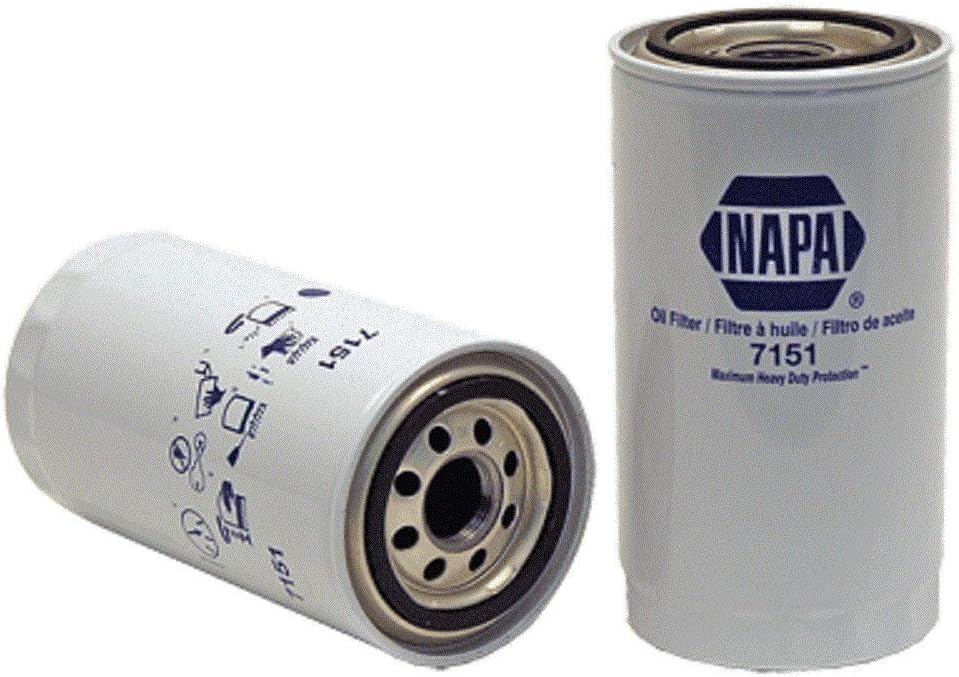
  • NAPA Gold Oil Filters Provide Excellent Engine Protection Using Conventional, Synthetic, or Synthetic-blended Motor Oils, As Recommended By The OE Vehicle Manufacturer
  • Laboratory Test Performance per ISO 454812: 18 Grams Dirt (NAPA Gold # 1515), 99% Efficient At 23 Microns (Based On NAPA Gold # 1515, 1356, 7060) – Has 13 Lb. By-Pass Relief Valve
  • Use For Normal And Severe Driving Conditions Such As Stop And Go Traffic, Dirt Roads, Construction Sites, Short Trips And Interstate Travel
  • This Filter Traps Up To 50% More Dirt And Contaminants Than ProSelect w/ The Best Combination Of Capacity & Efficiency For Severe Conditions. Use Gold For Manufacturer OE Recommended Oil Change Intervals

CHECK LATEST PRICE ON AMAZON


Fleetguard LF17494 Oil Filter

The Fleetguard Brand is a division of Cummins Filtration which has been defining quality filtration products since 1963. The Fleetguard LF17494 Oil Filter specifications on micron ratings are 100% efficiency at 30 microns and 60% efficiency at 10 microns.

  • Contains the Stratapore Filtration Media that is a multi-layered filter media
  • Oil filter media provides the optimum number of layers for particle removal
  • Oil filter provides a nearly 50% reduction in restriction during cold starts
  • It allows truck owners to extend service intervals without compromise
  • Cummins Filtration provides lube products that meet and exceed OE performance requirements and the new challenges of modern engine technology.


CHECK LATEST PRICE ON AMAZON


Baldwin B7379 Oil Filter

Baldwin lube filter spin-ons protect your engine from wear particles that can otherwise lead to premature parts failure. Longer drain intervals requires filters that have both high capacity and the ability to withstand the rigors of time and temperature without failing or going into bypass. Baldwin’s lube filters are up to the challenge.


  • Micron Rating 8 Absolute
  • Includes 20 PSID By-Pass Valve
  • Anti-Drainback Valve
  • Length 6 7/16 in
  • Outside Dia. 3 11/16 in
  • Compatible Competitor Part Number: Motorcraft FL2051


CHECK LATEST PRICE ON AMAZON


6.7 Powerstroke Oil change recommended intervals


Replace engine oil & oil filter 10,000 miles or as indicated by the instrument cluster message center
(Intelligent Oil Life Monitor system will adjust interval to driving conditions)


Read about engine oil filter ratings in this related article.
Engine Oil Filter Ratings Explained

Engine Oil Filter Ratings Explained

Filters are rated on their ability to remove particles of a certain size from a fluid, read the following article about engine oil filter ratings explained. For example, a filter that is rated as a “10 micron” filter can capture particles as small as 10 micrometers. The only way to know exactly what this means, however, is if the filter testing methods and rating standards utilized are both known.


The most commonly used filter ratings are nominal and absolute micron rating. Read the following article to understand how engine oil filter ratings are explained.


Nominal Rating


A nominal rating indicates the filter’s ability to prevent the passage of a minimum percentage of solid particles greater than the nominal rating’s stated micron size. These particles of each specific contaminant are measured by weight. The nominal rating also represents an efficiency figure or degree of filtration. A nominal rating example is “95% of 10 micron” – where the filter prevents 95% of all 10 micron and larger particles from passing through.


However, the nominal rating method is generally discouraged. During testing, differing conditions like operating pressure and contaminant concentration vary enough that the rating provides an inconsistent result and a lack of uniform measurement.


Absolute Rating


The absolute rating, or cut-off point, of a filter is the diameter of the largest spherical glass particle which will pass through the filter. These diameter dimensions are expressed in micrometers – or one/one millionth of a meter. The absolute rating reflects the pore opening size of the medium. Filter media with an exact and consistent pore size have an exact absolute rating.


This absolute rating should not be confused with the largest particle passed by a filter: the absolute rating simply determines the size of the largest glass bead that will pass through the filter under very low pressure differentials and non-pulsating conditions.


Filter media with exactly consistent pore sizes do not typically exist in practice. Pore size is affected by the form of the filter element and is not necessarily consistent with the actual open areas. It is possible for the shape of the particle, say if it is cylindrical, to allow the particle to pass through a much smaller hole in the media than would have been expected, based on at least one of the particle’s dimensions. This type of passage hinges on the size and shape of the opening and on the fluid depth over which filtering is provided.


A filter bed is typically created wherein particles collect on the media surface and result in an increased blocking action. This further decreases the permeability of the element. The blocking can increase so much that the pressure drop across the filter becomes excessive and the flow rate through the system drops dramatically.


Some see absolute rating as a non-realistic description. The term absolute means that no particle larger than that rating can pass through the filter, which limits the types of media to those with consistent pore size and ones that show a perfect retention of particles.


Beta Ratio


Up until recently, a universally accepted test method to measure the media pore size has not existed. A newer test procedure called multi-pass testing or Beta ratio testing has changed this. This method yields readily comparable test results and was introduced to give the filter manufacturer and the end user an accurate comparison between filter media.


Multi-pass testing uses a specified contaminate, of known sizes, added regularly in measured quantities to the fluid which is being pumped through the filter. At timed intervals, samples of the fluid are simultaneously taken from both downstream and upstream of the filter. Using particle counters, particles in each sample are measured and counted.


Based on the results of these measurements, a Beta ratio is determined by dividing the number of particles of a particular size in the upstream flow by the number of particles of the same size in the downstream flow. In essence, the Beta ratio is an indicator of how well a filter controls a specifically sized particulate.


For example, if one out of every two particles in a fluid pass through the filter, the Beta ratio is 2/1 = 2. This shows the number of particles upstream (2) divided by the number of particles downstream (1). Based on this method, filters with a higher beta ratio retain more particles, have a higher efficiency, and therefore are more effective filters.


Related Articles


Best oil filter for 6.7 Powerstroke


Best oil filter for Duramax Diesel Engines